What should Conroe property owners know about fence post installation?
- Fence-post design should reflect actual soil, drainage, fence height and openness, gate loads, corner forces, material, and installation method. Soil can vary across one property, so generic depth claims should not replace a site assessment and appropriate design.
- Confirm current property-specific requirements before installation.
- Compare complete written scopes, including gates, posts, removal, and exclusions.
Short answer: Fence-post design should reflect actual soil, drainage, fence height and openness, gate loads, corner forces, material, and installation method. Soil can vary across one property, so generic depth claims should not replace a site assessment and appropriate design.
This guide is for property owners who want to understand the structural basis of a fence. It provides practical planning guidance, not a substitute for a site assessment, survey, engineering, manufacturer instructions, HOA approval, or confirmation from the authority that governs a specific address.
Recognize different post jobs
Line posts support repeating panels, while corners, ends, and gates receive concentrated loads. They should not automatically share the same specification. For property owners who want to understand the structural basis of a fence, this decision should be recorded in the written scope so material, labor, and expectations stay aligned.
Look at the complete assembly rather than one visible component. Posts, rails or framework, fasteners, transitions, gates, ground clearance, finish, and access for future service all influence the result. Ask the installer to explain how the proposed detail responds to the actual site instead of relying on a generic rule.
Account for water and disturbance
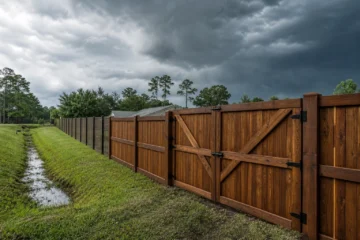
Fill areas, saturated low spots, roots, prior holes, trenches, and erosion can change support. Drainage correction may be part of a durable solution. For property owners who want to understand the structural basis of a fence, this decision should be recorded in the written scope so material, labor, and expectations stay aligned.
Look at the complete assembly rather than one visible component. Posts, rails or framework, fasteners, transitions, gates, ground clearance, finish, and access for future service all influence the result. Ask the installer to explain how the proposed detail responds to the actual site instead of relying on a generic rule.
Match posts to wind surface
Solid privacy panels, screens, and solid gates catch more wind than open pickets or mesh. Height and spacing also affect demand. For property owners who want to understand the structural basis of a fence, this decision should be recorded in the written scope so material, labor, and expectations stay aligned.
Look at the complete assembly rather than one visible component. Posts, rails or framework, fasteners, transitions, gates, ground clearance, finish, and access for future service all influence the result. Ask the installer to explain how the proposed detail responds to the actual site instead of relying on a generic rule.
Inspect the finished alignment
Check plumb, spacing, top line, movement, gate support, concrete or backfill finish, ground clearance, and drainage before the project is closed. For property owners who want to understand the structural basis of a fence, this decision should be recorded in the written scope so material, labor, and expectations stay aligned.
Look at the complete assembly rather than one visible component. Posts, rails or framework, fasteners, transitions, gates, ground clearance, finish, and access for future service all influence the result. Ask the installer to explain how the proposed detail responds to the actual site instead of relying on a generic rule.
A practical pre-project checklist
| Observation | What to record | Practical response |
|---|---|---|
| Define the job | write down the primary purpose, the people or animals affected, and the areas that must remain accessible. | Photograph and compare over time; request an assessment if the condition is active or creates a safety risk. |
| Confirm the line | use reliable property information and resolve uncertainty before excavation. An existing fence is not proof of a legal boundary. | Photograph and compare over time; request an assessment if the condition is active or creates a safety risk. |
| Locate constraints | identify utilities, easements shown in available documents, drainage, grade, roots, structures, and vehicle access. | Photograph and compare over time; request an assessment if the condition is active or creates a safety risk. |
| Specify gates | measure users, equipment, vehicles, swing or slide space, latches, hardware, and any access-control workflow. | Photograph and compare over time; request an assessment if the condition is active or creates a safety risk. |
| Compare written scope | review quantities, materials, posts, hardware, removal, cleanup, exclusions, and how changes will be approved. | Photograph and compare over time; request an assessment if the condition is active or creates a safety risk. |
| Confirm current requirements | check any applicable local, HOA, pool, commercial, or property-specific requirements before work begins. | Photograph and compare over time; request an assessment if the condition is active or creates a safety risk. |
Useful next pages on this site include wood fencing chain-link fencing driveway gates ask about your site conditions. These links connect the planning topic to services already offered by Conroe Fence Company rather than sending readers to unrelated pages.
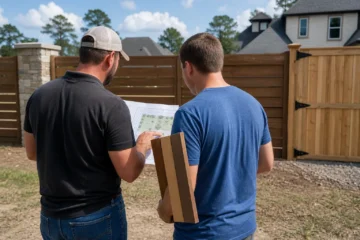
Before approving the work, walk the proposed line with the installer and review every corner, transition, gate, low spot, and access route. A short field review is the right time to correct assumptions, identify items that remain the owner’s responsibility, and make sure the drawing and written scope describe the same project.
Which primary sources support this guidance?
The following primary or standards-based resources explain the underlying safety, soil, material, or installation principles. Local codes and a site-specific assessment control the final scope.
Related local service: Fence Removal in Conroe, TX.
What are the main takeaways about fence post installation in Conroe?
Fence-post design should reflect actual soil, drainage, fence height and openness, gate loads, corner forces, material, and installation method. Soil can vary across one property, so generic depth claims should not replace a site assessment and appropriate design. The best next step is to turn the property’s real measurements, grade, drainage, gates, access, and intended use into a written scope. That process makes product comparisons clearer, reduces late design changes, and helps the homeowner or manager evaluate proposals on the same basis.
Discuss your Conroe-area fence project
Conroe Fence Company serves Conroe, The Woodlands, Willis, Spring, New Waverly, and Cleveland with residential, commercial, ranch, security, gate, and access-control options shown on this website. Request a property-specific conversation or call 936-506-2608. Recommendations and availability should be confirmed for your site.
Frequently Asked Questions
How deep should fence posts be in Conroe?
There is no universal depth for every property and fence. Soil, height, spacing, load, gate size, and design all matter.
Do gate posts need to be stronger?
Often, because they carry moving, concentrated loads from hinges, latches, or operators.
Is concrete always used around fence posts?
Methods vary by material, system, soil, and design. Ask for the specific installation method.
Can a new post use an old post hole?
Possibly, but the hole location, disturbed soil, remaining concrete, alignment, and design need evaluation.
What causes fence posts to lean?
Potential causes include inadequate support, soil movement, water, impact, wind load, rot or corrosion, and gate forces.